

- Home
- Wi-Fi installation
- Warehouse and industrial WiFi London
Warehouse and industrial WiFi London
Reliable wireless connectivity is critical to the smooth running of modern warehouses, distribution centres and industrial facilities. Scanners, vehicle-mounted terminals, voice picking and automated equipment all depend on it to keep goods and information moving.

Handheld scanners, vehicle-mounted terminals, stock-management systems, voice-picking technology, tablets and automated equipment may all depend on the wireless network.
SEGwifi provides specialist warehouse and industrial WiFi in London, designing commercial wireless networks around the real challenges of large, operational sites.
From initial RF surveys and network design to structured cabling, access-point installation, commissioning and final validation, we can deliver a complete wireless solution for warehouses, logistics operations and industrial buildings.
Specialist warehouse WiFi installation in London
Warehouse WiFi differs significantly from office WiFi.
A large open building may appear easier to cover. But steel racking, high ceilings, dense stock and constantly changing inventory can make warehouses some of the most challenging environments for wireless networking. A network that performs perfectly while a warehouse is empty may behave very differently when the racking is fully stocked.
SEGwifi therefore takes a survey-led approach to warehouse WiFi installation in London, considering how the building actually operates rather than relying solely on floor plans or simple coverage calculations.
We look at where staff work, where devices travel, what the racking contains and which areas need continuous connectivity before deciding where to position access points. More on warehouse and logistics WiFi.
Why warehouse WiFi requires specialist design
Poorly designed warehouse wireless networks create operational problems that go far beyond slow internet access.
A dropped connection can interrupt a barcode scan, stop a picking transaction or disconnect a warehouse-management terminal while a worker moves between aisles. That makes consistency and roaming just as important as headline WiFi speed.
Steel racking and changing stock levels
Steel warehouse racking can reflect radio signals, while the products stored on it may absorb them. Dense products such as liquids, canned goods, foil packaging and other materials containing metal or water can significantly affect wireless propagation.
The difficulty is that these conditions change. A warehouse with partially empty racking can have very different RF characteristics from the same warehouse at peak stock levels.
That is why we recommend surveying warehouses under representative operating conditions, rather than treating an empty building as a realistic test environment. Why warehouse racking kills 5 GHz WiFi.
WiFi designed around warehouse aisles
A warehouse is rarely one uniform space. Narrow aisles, wide aisles, loading bays, packing areas, mezzanines and open dispatch zones can all need different approaches.
Narrow-aisle WiFi
Tall racking on both sides of a narrow aisle can channel wireless signals along the aisle while stopping useful coverage from spreading into adjacent aisles. As a result, an access point that appears to cover several aisles on a basic floor plan may provide reliable connectivity in only one.
Directional antennas and carefully planned access-point positioning help control where the wireless signal is directed.
Wide-aisle and open areas
Open areas create a different challenge. Signals may travel much farther, increasing the risk of access points competing for airtime if power levels and channel planning aren't configured correctly.
Our approach to industrial WiFi installation in London therefore treats each area according to its RF characteristics, rather than applying the same antenna and power settings throughout the building.
Warehouse WiFi surveys in London
A professional WiFi survey provides the foundation for a reliable warehouse wireless network. Our engineers can assess the site aisle by aisle and consider:
- Racking layout
- Stock density
- Product types
- Ceiling heights
- Access-point mounting locations
- Existing wireless coverage
- Interference
- Device requirements
- Loading and dispatch areas
- Yard coverage
- Mezzanine levels
- Existing network infrastructure

A survey helps when designing a completely new network or diagnosing an existing warehouse WiFi system that produces unreliable connections. See our on-site surveys and WiFi heatmap surveys.
WiFi for handheld scanners and warehouse devices
One of the most important parts of warehouse wireless design is understanding the client devices that will actually use the network. A laptop may hold a connection in conditions where a handheld scanner struggles.
Warehouse equipment can include:
- Barcode scanners
- Handheld terminals
- Voice-picking headsets
- Vehicle-mounted terminals
- Tablets
- Mobile printers
- Forklift-mounted equipment
- Warehouse management devices
- IoT sensors
- Automated systems and AGVs
These devices often have different antenna capabilities, transmit power and roaming behaviour. SEGwifi therefore designs and validates warehouse networks around the operational devices wherever possible, rather than assuming a successful laptop test proves everything else will work.
Reliable roaming across warehouses and industrial sites
Warehouse staff rarely stay in one place. Pickers, forklift operators and warehouse teams move continuously between aisles, loading areas, packing stations and dispatch zones, and the wireless network needs to support that movement.
Poor roaming can keep a device connected to an access point several aisles away instead of switching to a closer one. Eventually the connection becomes too weak and the session drops.
Professional warehouse wireless network installation in London considers access-point placement, transmit power, channel planning and client behaviour to create better roaming conditions throughout the site. More on roaming for scanners and AGVs.
High-level warehouse WiFi installation
Large warehouses often need access points and cabling installed at considerable height. However, simply mounting every access point on the highest available roof steel is not necessarily the best solution.
If equipment is positioned too high, much of the useful radio energy may stay above the working area rather than reaching scanners and terminals at floor or picking height.
SEGwifi considers antenna type, mounting height, angle and RF requirements when deciding how to install access points. Where necessary, projects can involve suitable access equipment, containment, cabling and carefully planned working-at-height procedures.
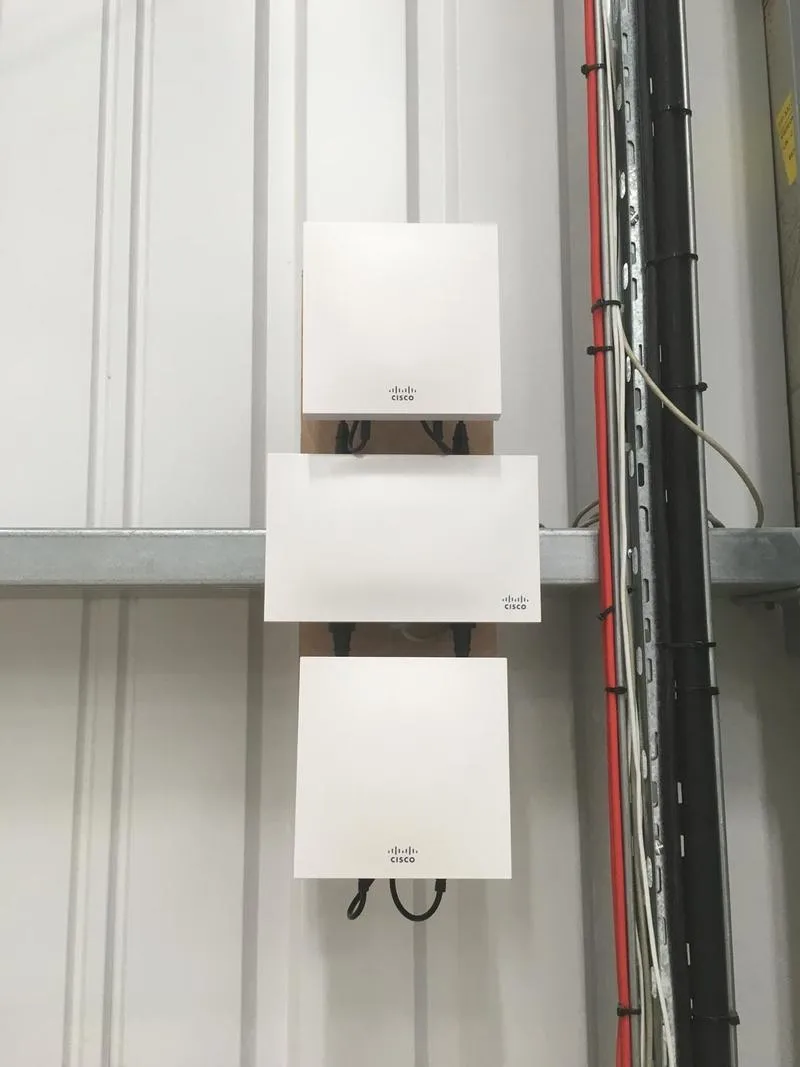
Structured cabling for industrial WiFi networks
Wireless networks still depend on reliable wired infrastructure. SEGwifi can provide the structured cabling needed to connect warehouse access points back to the network. This can include:
- Cat6A cabling
- Fibre infrastructure
- High-level containment
- Data cabinet connections
- Cable termination
- Testing and certification
- Labelling
- Patching
Keeping the WiFi design, cabling and physical installation within the same project also reduces the risk of access points being installed wherever the easiest cable route happens to be, rather than where the wireless design needs them.
WiFi for loading bays, yards and external areas
Warehouse connectivity does not always stop at the building perimeter. Loading bays, external yards, trailer areas and the transition between internal and external spaces may all need reliable wireless coverage.
These transition points matter most where staff move continuously between indoor and outdoor areas while using handheld devices.
Depending on the site, we can include these operational areas in the wireless survey and design, so the network supports the complete workflow, not just the warehouse floor. Outdoor and high-bay sites often suit platforms such as Ruckus, Aruba and Cambium.
Warehouse WiFi without stopping your operation
Many logistics and industrial businesses operate long hours, and some run around the clock. Closing the warehouse simply to replace the WiFi network may not be practical.
SEGwifi can plan installation work around operational requirements, including:
- Aisle-by-aisle deployment
- Phased installation
- Night working
- Weekend installation
- Planned shutdown periods
- Coordination with warehouse operations teams
Working arrangements are agreed before installation begins, so access equipment, pedestrian segregation and operational requirements can all be considered.
Troubleshooting existing industrial WiFi
Not every poorly performing warehouse network needs a full replacement. Sometimes the existing hardware is capable, but the design, positioning or configuration is wrong. Common warehouse WiFi problems include:
Access points installed too high
Coverage may appear broad but provide weak performance at scanner level.
Too much transmit power
Increasing power is often used as a quick fix, but it can increase interference and make roaming problems worse.
Incorrect antenna choice
Using the same omnidirectional antenna throughout a warehouse may not suit narrow aisles or specialist areas.
Poor channel planning
Too many radios competing on the same channels can reduce performance.
Design based on an empty warehouse
Networks designed before stock arrives may not perform reliably once the racking is full.
Poor roaming
Scanners may stay connected to distant access points for too long before switching.
A professional survey can identify the underlying cause before you spend money on unnecessary replacement hardware. More on WiFi troubleshooting.
Post-installation WiFi validation
Warehouse WiFi should be tested once the installation is complete.
SEGwifi can re-survey the site to compare real-world performance against the wireless design, including aisles, loading areas, yards and transition zones where required.
This provides evidence that the network has achieved the agreed coverage and performance objectives, rather than relying on a basic visual check of WiFi signal strength. More on validation surveys.
Why choose SEGwifi for warehouse and industrial WiFi in London?
SEGwifi specialises in commercial wireless environments where network reliability matters to day-to-day operations. Our warehouse WiFi services can include:
- On-site WiFi surveys
- RF heatmapping
- Warehouse wireless design
- Access-point and antenna specification
- Structured Cat6A and fibre cabling
- High-level installation
- Access-point mounting
- Network configuration
- Roaming optimisation
- Troubleshooting
- Post-installation validation
- Managed WiFi support
We also understand that a warehouse needs to keep operating while work is completed. SEGwifi plans installations around shifts, access requirements and operational constraints, so the wireless project fits around the business rather than the other way round. See how this worked for a densely racked pick operation in our Magic Madhouse case study.
Improve your warehouse WiFi in London
Unreliable wireless coverage quickly becomes an operational problem when scanners, terminals and warehouse systems depend on continuous connectivity.
Whether you are opening a new facility, expanding an existing warehouse or trying to resolve long-standing WiFi problems, SEGwifi can help you understand exactly what your site needs. From the first RF survey through design, cabling, installation and validation, we provide a complete approach to warehouse and industrial WiFi in London.
Speak to SEGwifi today about your warehouse WiFi requirements and arrange a professional site survey. For other building types, see business WiFi installation in London.
FAQs about warehouse and industrial WiFi in London
Why does warehouse WiFi become worse when the racking is full?
Stock can absorb and block wireless signals, particularly dense products containing liquids, metals or foil packaging. A network tested in an empty warehouse may therefore behave differently once stock levels increase. This is one reason warehouse surveys should reflect realistic operating conditions.
How many WiFi access points does a warehouse need?
No reliable calculation exists based purely on square footage. Racking layout, stock type, ceiling height, aisle design, client devices and required coverage all influence the number and positioning of access points.
Can you improve an existing warehouse WiFi network?
Yes. A survey can identify problems involving coverage, interference, access-point placement, antenna choice, power levels, channel planning and roaming. In some cases, you can retain and optimise the existing hardware instead of replacing it.
Can warehouse WiFi support barcode scanners and forklift terminals?
Yes, but the network should be designed around those devices. Handheld and vehicle-mounted terminals can behave differently from laptops, so the design and validation should use the devices that will actually run on site.
More for London sites: business WiFi installation, office WiFi installation, managed WiFi, point-to-point wireless links.
Let's find out what your Wi-Fi is actually doing.
Book a survey and you get measured data, a design you can build to, and a number you can budget against — not an opinion.
Our cabling, containment and power are installed under the group's accreditations — NICEIC, Constructionline Gold, CHAS and SafeContractor, held by The Specialist Electrical Group Ltd.




Talk to SEGwifi
Tell us about the building and what is going wrong. We will come back within one working day with the survey that answers it — or tell you that you do not need one.